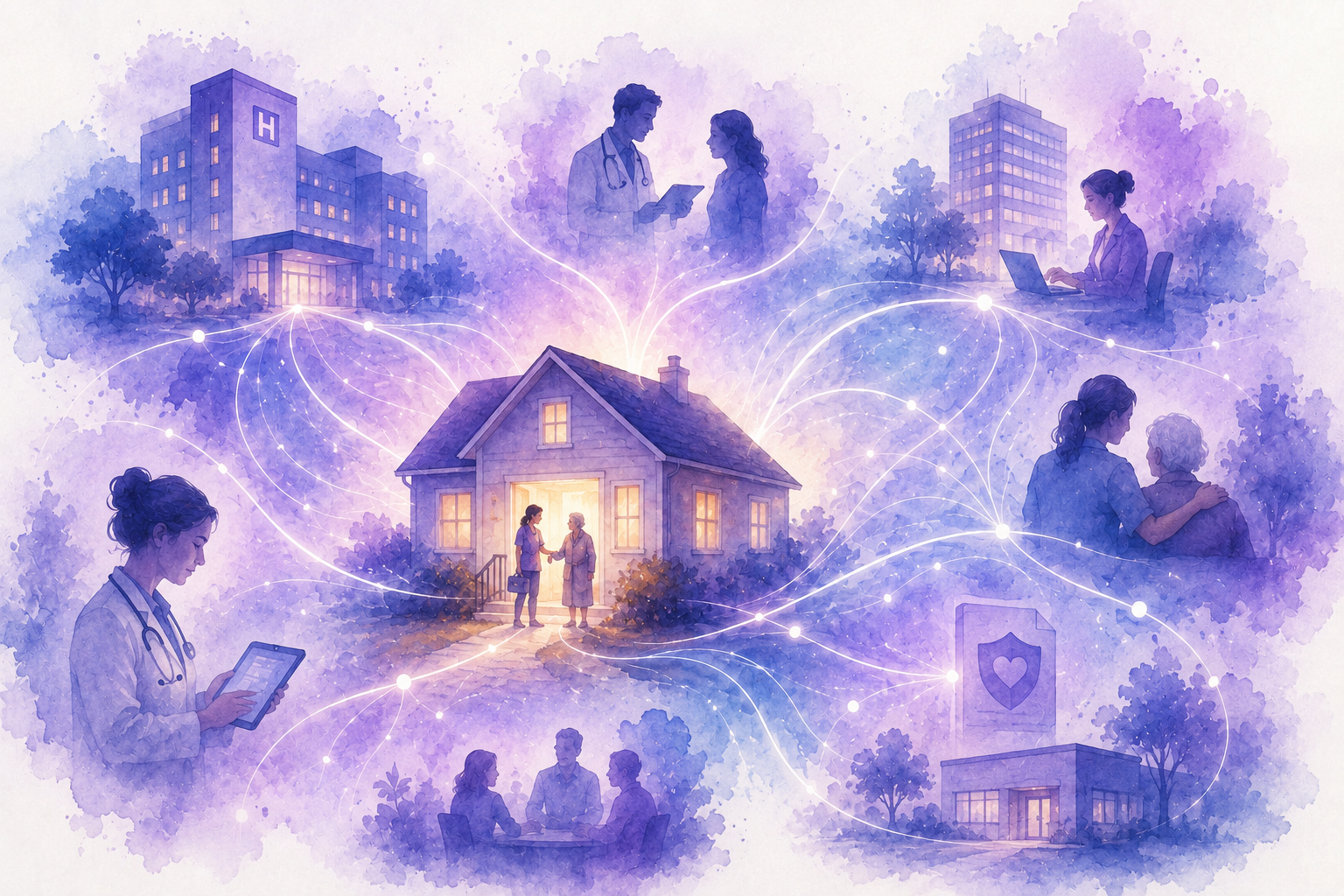
Healthcare organizations increasingly carry responsibility for what happens across time, but most healthcare infrastructure still operates around discrete encounters: a hospital stay, a clinic visit, a home health episode, a care management call, a claim. Each moment matters. None of them, by itself, creates continuity.
The highest-risk members do not become high risk only when they enter a hospital or visit a physician. Their risk accumulates at home, between visits, in the daily decisions, barriers, symptoms, habits, and missed signals that determine whether a care plan becomes real.
This is why home health is such an important starting point for continuous care. Home health sits at the edge of the formal healthcare system and the member’s lived reality. It is often the first organized part of healthcare to re-enter the home after a hospitalization, surgery, exacerbation, fall, functional decline, or change in condition. It sees what the rest of the system needs to know but often cannot observe continuously.
Home health is not just a service category. It is a network node connecting hospitals, providers, payers, caregivers, and members at the exact moment when continuous care matters most.
Much of healthcare is organized around institutions. Hospitals are designed for acute care. Primary care is designed around visits. Specialists focus on defined clinical domains. Health plans manage benefits, networks, and financial risk. Each plays an essential role, but the member’s life does not unfold inside those structures. It unfolds at home.
At home, the discharge instructions may or may not be understood. The medication list may or may not match what is actually on the kitchen table. The member may or may not have food, transportation, caregiver support, confidence, mobility, sleep, or a safe path to the bathroom. A blood pressure reading, a weight change, a missed medication, a shortness-of-breath episode, or a change in mood may be the early signal of deterioration.
These are not peripheral issues. For clinically complex people, they are often the operating conditions of health. A care plan can be clinically correct and still fail if it cannot survive the realities of daily life. Home health is one of the few parts of the healthcare system positioned to see that reality directly.
A home health nurse, therapist, or aide enters the environment where the care plan must be carried out. They can see whether the member can move safely, whether instructions are clear, whether the caregiver is overwhelmed, whether the home supports recovery, and whether small barriers are accumulating into clinical risk. That makes home health highly informative. It is not only delivering a service. It is observing the context on which every other service depends.
This is also why home health can create a natural introduction to continuous care. The member is not receiving an abstract outreach call from a distant organization. They are being supported at a moment when help is expected and often welcomed. Trust is easier to establish because the need is visible, immediate, and practical.
For many members, the home health episode is the first time the system’s intentions become tangible after a transition. Someone comes into the home. Someone looks at the pill bottles. Someone watches the member stand, walk, breathe, eat, remember, and recover. That moment matters because it reveals whether the plan is actually becoming care.
The limitation of home health is not that it fails. The limitation is that it is episodic. It is designed to support a defined period of recovery or skilled need. When that episode ends, the member’s underlying risk often continues. Chronic disease, functional vulnerability, medication confusion, loneliness, transportation barriers, diet challenges, symptom changes, and caregiver strain do not follow episode boundaries.
This is one of the central discontinuities in healthcare: the system organizes support into episodes, but the member experiences risk longitudinally. Continuous care begins by recognizing that the end of an episode is not the end of responsibility. It is a vulnerable handoff point, and it is also a strategic opportunity.
When home health is connected to a continuous care operating system, the episode becomes more than a short-term intervention. It becomes the beginning of a longitudinal relationship. The signals gathered during and after the episode can help shape an individualized Digital Twin for Health™. Daily engagement through IbisHub™ can continue after formal visits end. The member can be guided, reminded, educated, and supported as they return to daily life. The care team can detect change, prioritize action, and escalate before deterioration becomes an emergency.
This is where home health becomes strategically powerful for a broader network. It creates a practical starting point for continuous care because it begins close to the member, close to the transition, and close to the signals that drive avoidable utilization. In this model, home health is not replaced. It is extended. The episode creates a trusted bridge into a longer care relationship.
The continuous care operating system maintains state, detects change, guides action, and connects the right human roles over time. That operating system matters to hospitals because they are deeply affected by what happens after discharge. A technically successful admission can still fail if the member returns home without enough continuity. Readmissions, emergency visits, poor recovery, medication issues, and avoidable post-acute utilization all reflect the gap between discharge and daily life.
Home health already sits in that gap. It receives members when the transition is still fresh, sees whether the discharge plan is working, and identifies where the plan is breaking down. When paired with continuous care, home health can help hospitals extend their influence beyond the walls of the institution without trying to become a daily care organization themselves. The hospital’s discharge becomes part of a continuing system of observation, engagement, and response.
Plans and accountable care organizations should care for the same reason. They are responsible for cost and outcomes across time. Their challenge is not only identifying high-risk members. It is keeping those members stable in the daily environments where risk develops. Home health offers access to a population and a moment that matter: members with recent instability, functional change, or escalating complexity.
But plans and ACOs need more than an episode. They need a way to sustain engagement, detect deterioration, close gaps, and learn from what happens. A continuous care operating system can transform home health from a temporary service into a launch point for longitudinal risk management.
Primary care should care as well. Primary care clinicians are often accountable for patients they cannot observe every day. They carry responsibility for medication management, chronic disease stability, preventive care, behavioral health needs, and coordination across specialists and facilities, yet their visibility is episodic. Home health can surface practical context that primary care rarely sees. Continuous care can preserve and act on that context after the home health episode ends.
Instead of asking primary care to do more with the same visit-based infrastructure, a continuous care operating system can give primary care better signal, better follow-through, and better confidence that members are being supported between visits.
A single home health relationship can touch many parts of the healthcare network. Home health agencies receive referrals from hospitals. They coordinate with physicians. They interact with caregivers. They serve members whose costs and outcomes matter to plans, ACOs, and health systems. That makes home health a powerful network node, not an isolated channel. It is the most practical front doors to continuous care.
For health systems and plans, the strategic question is no longer whether care should extend beyond the encounter. It already must. The question is where to begin building the infrastructure for that reality.
The answer may be where the member already is: at home.