Value-based care fundamentally changes the economics of healthcare.
Instead of being paid primarily for encounters and procedures, healthcare organizations increasingly take responsibility for what happens to people over time: whether their conditions remain controlled, whether avoidable hospitalizations occur, whether care is coordinated, and ultimately whether better outcomes are achieved at lower cost.
That shift makes sense.
But it creates an operating problem that healthcare has not fully solved.
You cannot take continuous responsibility for outcomes with episodic infrastructure.
Most healthcare infrastructure was built around encounters. A patient sees a physician. A home health nurse makes a visit. A specialist performs a consultation. A hospital manages an admission. Each organization does its work, documents what happened, and moves on to the next encounter.
Value-based care changes the accountability without necessarily changing that underlying operating model.
Now an organization may be financially responsible for what happens between those encounters as well.
Did the patient take the medication?
Is shortness of breath getting worse?
Did the patient understand the discharge instructions?
Did the specialist's recommendation make it into the care plan?
Did transportation prevent a follow-up appointment?
Is anxiety contributing to poor adherence?
Did someone notice the three small changes that, taken together, signal an impending hospitalization?
Claims data may eventually reveal what happened. The medical record may document pieces of it. Risk models may identify who is statistically likely to have a problem.
But none of those, by themselves, provide a continuous operating layer for knowing what is happening now and coordinating what should happen next.
That is the missing infrastructure.
From episodic information to continuous understanding
Healthcare Continuity Infrastructure begins with a different assumption: if an organization is responsible for outcomes over time, it needs the ability to understand and act over time.
That requires more than collecting additional data.
It requires a continuous learning cycle.
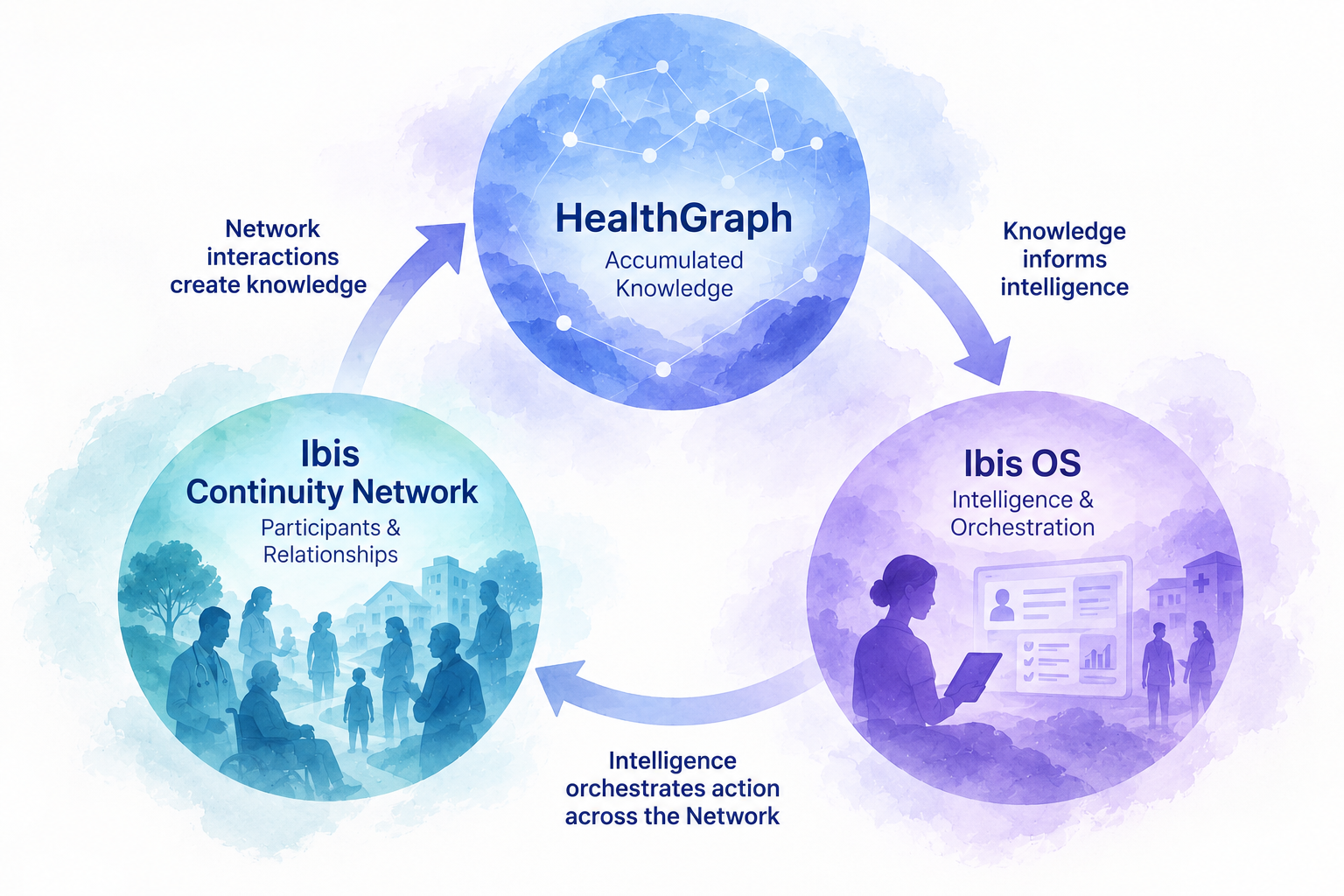
The Network creates observations, relationships, actions, and outcomes.
HealthGraph™ turns those interactions into accumulated knowledge.
The Ibis™ OS uses that knowledge to continuously understand current state, detect meaningful change, and orchestrate the right action by the right person at the right time.
Those actions create new observations and outcomes, which return to the Network and become additional knowledge.
The cycle continues:
Network → HealthGraph™ → OS → stronger Network.
This is not simply a data flywheel.
It is an operating flywheel.
Every interaction has the potential to make the system better at understanding what is happening and determining what should happen next.
And as orchestration improves, participation in the Network becomes more valuable to everyone involved.
Why the Network matters
Complex patients rarely receive care from one organization.
There may be a primary care practice, specialists, home health agency, behavioral health provider, pharmacy, hospital, community organizations, caregivers, and family members.
Value-based contracts may assign economic responsibility to one entity, but the outcome is produced by the collective actions of many.
That makes coordination fundamental.
The Ibis Continuity Network connects recurring sources of patient demand with distributed clinical capacity and the other people and organizations involved in care. The Network creates the relationships through which continuity becomes possible.
But relationships alone are not enough.
The operating layer must continuously understand what is happening across those relationships and help the right participant act when something changes.
That is the role of the OS.
Why accumulated knowledge matters
A snapshot tells you what is happening at one moment.
Accumulated knowledge tells you what that moment means.
A five-pound weight increase has different significance for different people. So does a missed medication, a poor night's sleep, a change in mood, a new symptom, or a missed appointment.
The meaning comes from context: the person's history, conditions, medications, behaviors, prior responses, care plan, social circumstances, and the sequence of events leading to the present moment.
HealthGraph™ accumulates that context.
Over time, each observation, action, and outcome contributes to a richer longitudinal understanding of the person and of care itself.
That accumulated knowledge gives the OS something a static risk score cannot provide: context for interpreting what is happening now.
From prediction to orchestration
Much of value-based care has understandably focused on prediction.
Who is high risk?
Who is likely to be hospitalized?
Which population should receive additional intervention?
Those are useful questions.
But identifying risk does not change an outcome.
Action does.
Once a system identifies that something matters, another set of questions begins:
What should happen next?
Who should act?
How urgently?
What does the patient need to do?
Did the action happen?
Did it work?
What should happen if it did not?
That is the transition from analytics to operations — and from prediction to orchestration.
The OS continuously makes that transition, connecting understanding to action and action back to learning.
Making value-based economics operational
Value-based care and Healthcare Continuity Infrastructure solve different parts of the same problem.
Value-based care changes the incentive structure. It makes healthcare organizations economically responsible for keeping people healthier and avoiding unnecessary utilization.
Healthcare Continuity Infrastructure provides the operating capability required to act on that responsibility continuously.
Without it, organizations are still largely trying to manage longitudinal risk using episodic encounters, fragmented workflows, and retrospective information.
With it, the economic model and operating model begin to align.
The organization responsible for an outcome gains infrastructure for continuously understanding the people for whom it is responsible, detecting meaningful change, coordinating the people who can intervene, and learning from what happens next.
That is what makes the virtuous cycle important.
The Network generates experience.
HealthGraph™ accumulates knowledge from that experience.
The OS turns that knowledge into better understanding and better orchestration.
Better orchestration produces better outcomes and makes the Network more valuable.
And every turn of the cycle strengthens the next.
Value-based care changes the economics of healthcare. Healthcare Continuity Infrastructure makes those economics operationally achievable.
Value-based care cannot reach its full potential without a continuous operating layer that learns from every patient interaction and turns that learning into better action.