Continuous accountability requires continuous operating capability.
Value-based care makes organizations responsible for outcomes over time. Ibis™ gives them the infrastructure to continuously understand what is happening, recognize meaningful change, coordinate action across the Care Circle, and close the loop before avoidable deterioration becomes utilization.
The intervention is not a disease protocol. It is continuity.

We did not build multiple disease-management programs.
We built the infrastructure that allows multiple clinical pathways to operate continuously.
Different diseases require different clinical knowledge, treatments, and providers. But people living with complex chronic conditions share a common operating problem: their health changes continuously, often unnoticed.
Ibis addresses that underlying problem. It maintains an evolving understanding of the member, recognizes meaningful change, determines who should act, activates the appropriate person in the Care Circle, and follows through until the loop is closed.
The disease determines what care is needed. Continuity determines whether that care happens at the right time.
Value-based care needs a continuous operating layer.
Ibis creates a virtuous cycle that turns everyday interactions into accumulated knowledge, accumulated knowledge into better intelligence, and better intelligence into more effective action across the network.
Ibis Continuity Network
Members, caregivers, clinicians, provider organizations, and other participants create observations, relationships, actions, and outcomes through everyday care.
HealthGraph™
Those interactions become accumulated longitudinal knowledge about the member, their history, context, responses, and care relationships.
Ibis OS
The operating system uses that knowledge to understand current state, detect meaningful change, and orchestrate the right action by the right person at the right time.
Stronger Network
Better orchestration improves outcomes. Each new action and outcome creates additional knowledge, making the next decision better informed.
Network → HealthGraph™ → Ibis OS → stronger Network.
Across 1,896 members with chronic conditions, continuity is associated with substantially lower utilization.
The result is not tied to a single disease pathway. When members are actively supported through Ibis, emergency visits, hospitalizations, readmissions, and average stay length are all lower than during comparable off-Ibis periods.
Utilization rates are per 1,000 patients per year. Average stay length is shown in days. “On” reflects periods when members were actively supported through Ibis; “Off” reflects comparable periods without that continuity.
The continuity effect persists across very different chronic conditions.
Heart failure, kidney disease, COPD/asthma, diabetes, hypertension, and anxiety/depression destabilize in different ways and require different clinical responses. Yet each shows the same broad pattern: lower utilization when care remains continuous.
| Condition | ER visits | Hospitalizations | Readmissions | Average stay length |
|---|---|---|---|---|
| CHF n=169 |
↓ 30.20% | ↓ 62.09% | ↓ 76.43% | ↓ 41.91% |
| Kidney Disease n=515 |
↓ 31.30% | ↓ 63.28% | ↓ 75.59% | ↓ 43.60% |
| COPD/Asthma n=747 |
↓ 24.66% | ↓ 55.93% | ↓ 68.95% | ↓ 43.59% |
| Diabetes n=782 |
↓ 25.90% | ↓ 57.17% | ↓ 75.45% | ↓ 38.96% |
| Hypertension n=1,660 |
↓ 25.56% | ↓ 58.30% | ↓ 71.32% | ↓ 52.24% |
| Anxiety/Depression n=996 |
↓ 22.87% | ↓ 56.53% | ↓ 72.33% | ↓ 44.58% |
Continuity is not disease-specific infrastructure. It is the common operating layer beneath many clinical pathways.
Identifying risk does not change an outcome. Action does.
Value-based care has invested heavily in risk stratification and prediction. Those tools can identify who is more likely to deteriorate or use costly services. But they do not, by themselves, ensure that the right action happens when conditions change.
Ibis adds the missing operating loop: understand what is happening now, detect what changed, determine who should act, activate that person or system, and continue following the situation until the loop is closed.
The clinical response may differ by condition. The continuity infrastructure remains the same.
Continuity becomes more consequential as acuity rises.
Over time, Senscio has supported a growing share of members entering through home health discharge pathways and other higher-acuity settings—populations with greater baseline instability and faster deterioration between encounters.
When members are actively engaged, Ibis has current information to maintain persistent understanding, detect meaningful change, and trigger timely action. When engagement lapses, those data-driven activations do not occur. As case mix shifts toward higher-acuity populations, the value of continuity becomes more visible.
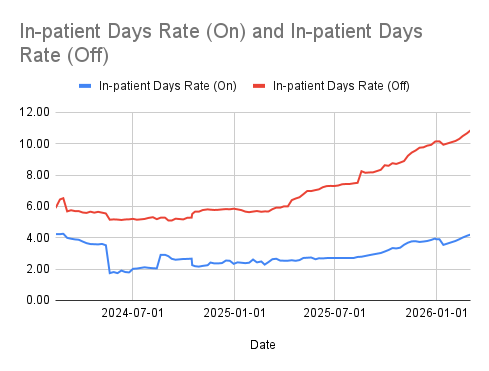
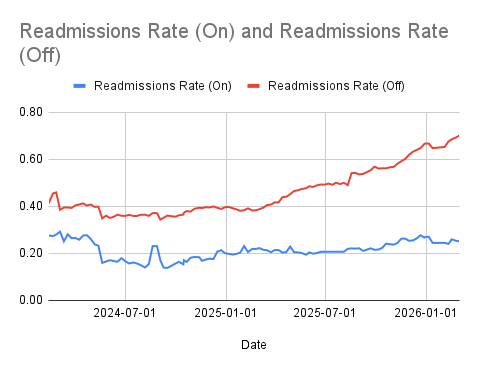
As acuity increases, the marginal value of continuous care rises. Persistent understanding and timely action help attenuate escalation, shorten avoidable cascades, and reduce the burden of hospitalization and readmission.
Value-based care changes the economics. Healthcare Continuity Infrastructure makes those economics operationally achievable.
Value-based care asks organizations to take responsibility for what happens to members over time. Healthcare Continuity Infrastructure gives them the continuous operating capability to act on that responsibility.
The outcomes above show what becomes possible when an organization responsible for longitudinal outcomes also has the infrastructure to understand and act longitudinally.
You cannot take continuous responsibility for outcomes with episodic infrastructure.
See how Ibis can add continuous operating capability to your value-based care model.
Ibis adds Healthcare Continuity Infrastructure to the providers, systems, and relationships you already have.