Clinical judgment keeps continuity moving
Healthcare Continuity Infrastructure does not replace the clinicians already caring for the member. It helps keep those clinicians connected and engaged when action is needed.
Ibis™ maintains persistent understanding of the member, detects meaningful change, and determines who should do what, when, why and how.
Clinical judgment is then applied where continuity requires interpretation, escalation, coordination, or follow-through.
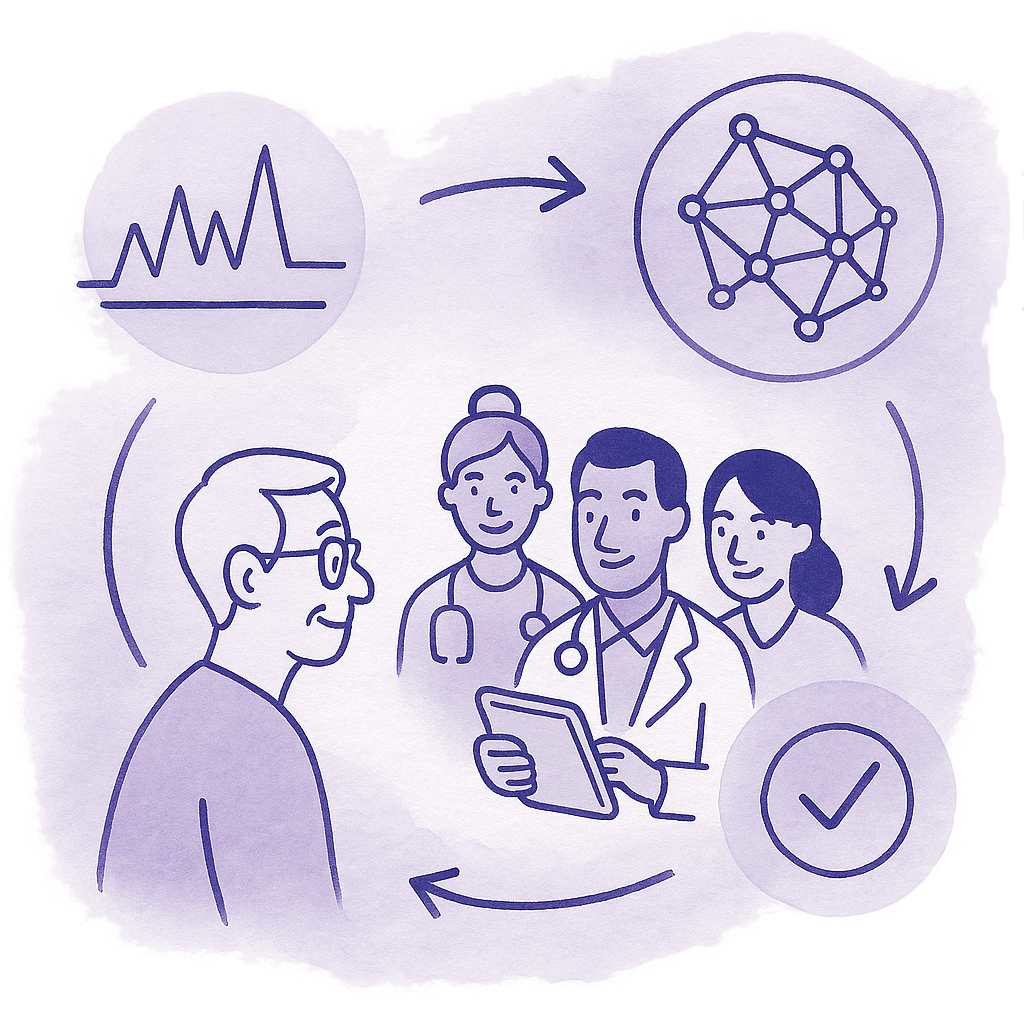
Continuous care requires clinical judgment without replacing treating providers
The member already has a Care Circle: the people and organizations through which the member receives care. Primary care, specialists, hospitals, home health, pharmacists, caregivers, and community organizations each continue to perform their existing roles.
What has been missing is longitudinal clinical responsibility for continuity—the ability to recognize when care is stalling, determine who should act, route or escalate the issue, and make sure the necessary clinical decision is made by the appropriate provider at the appropriate time.
Clinical judgment
Some situations require professional interpretation of risk, urgency, and who needs to act next.
Routing and escalation
When action is needed, the right issue must reach the right provider without unnecessary delay.
Coordination
Different members of the Care Circle step in and step out as the member’s needs change.
Follow-through
Continuity is not complete until the necessary action happens and the loop is closed.
The goal is not to take over care. It is to make sure every necessary clinical decision is made by the appropriate provider at the appropriate time.
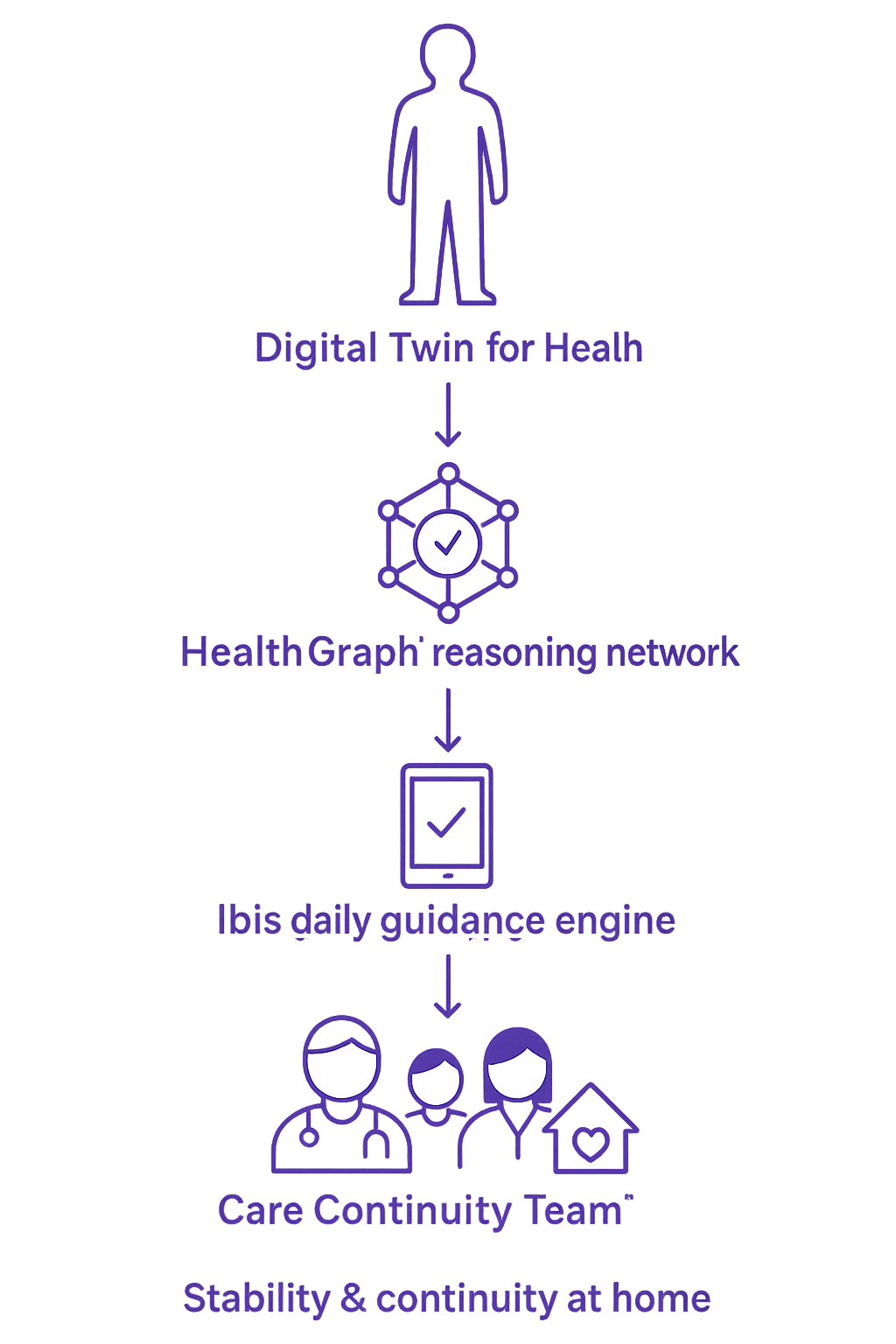
Ibis keeps the Care Circle moving
The clinical model sits inside Healthcare Continuity Infrastructure. Ibis maintains persistent understanding of the member and identifies when continuity requires action.
- Digital Twin for Health™ (DT4H) maintains the member’s evolving health state
- HealthGraph™ connects the member with their Care Circle and the broader network
- Ibis detects meaningful change and determines who should do what, when, why and how
- Clinical partners apply judgment when interpretation, escalation, or coordination is needed
- Treating providers continue to diagnose and determine treatment within their existing roles
The result is a continuous loop in which technology maintains understanding and clinical judgment keeps care moving through the member’s existing network.
Clinical responsibility for continuity is different from treatment responsibility
1. Recognize when continuity requires intervention
Ibis surfaces meaningful change; clinical judgment helps determine whether the change requires action and how urgent that action should be.
2. Engage the appropriate provider
The goal is to bring the right member of the Care Circle into the situation rather than duplicate that provider’s role.
3. Coordinate across the Care Circle
When several people or organizations are involved, the continuity function keeps the sequence of actions connected.
4. Follow until the issue is resolved
The continuity function does not stop at an alert or referral. It follows the issue until the necessary action is completed and the member’s state is understood again.
Different clinical organizations can participate in continuous care
Ibis is designed to work with the healthcare system that already exists. Depending on the deployment, hospitals, medical practices, home health organizations, specialists, pharmacists, and other clinical partners may all participate in the member’s Care Circle.
Continuity responsibility
A qualified clinical partner can accept longitudinal responsibility for keeping continuity moving.
Treating providers
Primary care physicians, specialists, hospital clinicians, and others continue to diagnose and determine treatment.
Continuity operations
Ibis and the supporting continuity workforce track open loops, route action, and support follow-through.
Member and caregivers
The member remains the primary actor whenever self-management or caregiver action is the right next step.
Clinical judgment is supported by an explicit healthcare model
Ibis uses governed healthcare knowledge to interpret member state, recognize meaningful change, and determine what actions are appropriate. Clinical knowledge can evolve without hardwiring every change into software.
- Healthcare knowledge is represented explicitly rather than buried in application code
- Clinical pathways and escalation logic can evolve as evidence and practice change
- Human judgment remains available when context, ambiguity, or safety requires it
- Actions remain explainable in terms of the member’s state and the underlying healthcare model
- The same operating model can be deployed across different provider organizations and populations
What this clinical model makes possible
Earlier action
Meaningful change can be recognized and routed before deterioration becomes acute.
Connected care
Different providers can step in and step out without losing continuity around the member.
Lower clinical burden
Treating providers are engaged when their expertise or authority is needed rather than being asked to supervise every daily change.
Longitudinal accountability
Someone remains responsible for making sure necessary clinical decisions occur and open loops close.
Healthcare Continuity Infrastructure keeps the member understood; clinical judgment keeps care moving.
See continuous care in action.
Walk through a real member week, explore outcomes, or talk with us about how Ibis can add continuity capability to your existing clinical operations.