What is continuous care?
Continuous care is achieved when the right action is taken by the right person at the right time in an effective way.
Healthcare Continuity Infrastructure makes this possible by continuously understanding the member and engaging the Care Circle whenever action is needed.
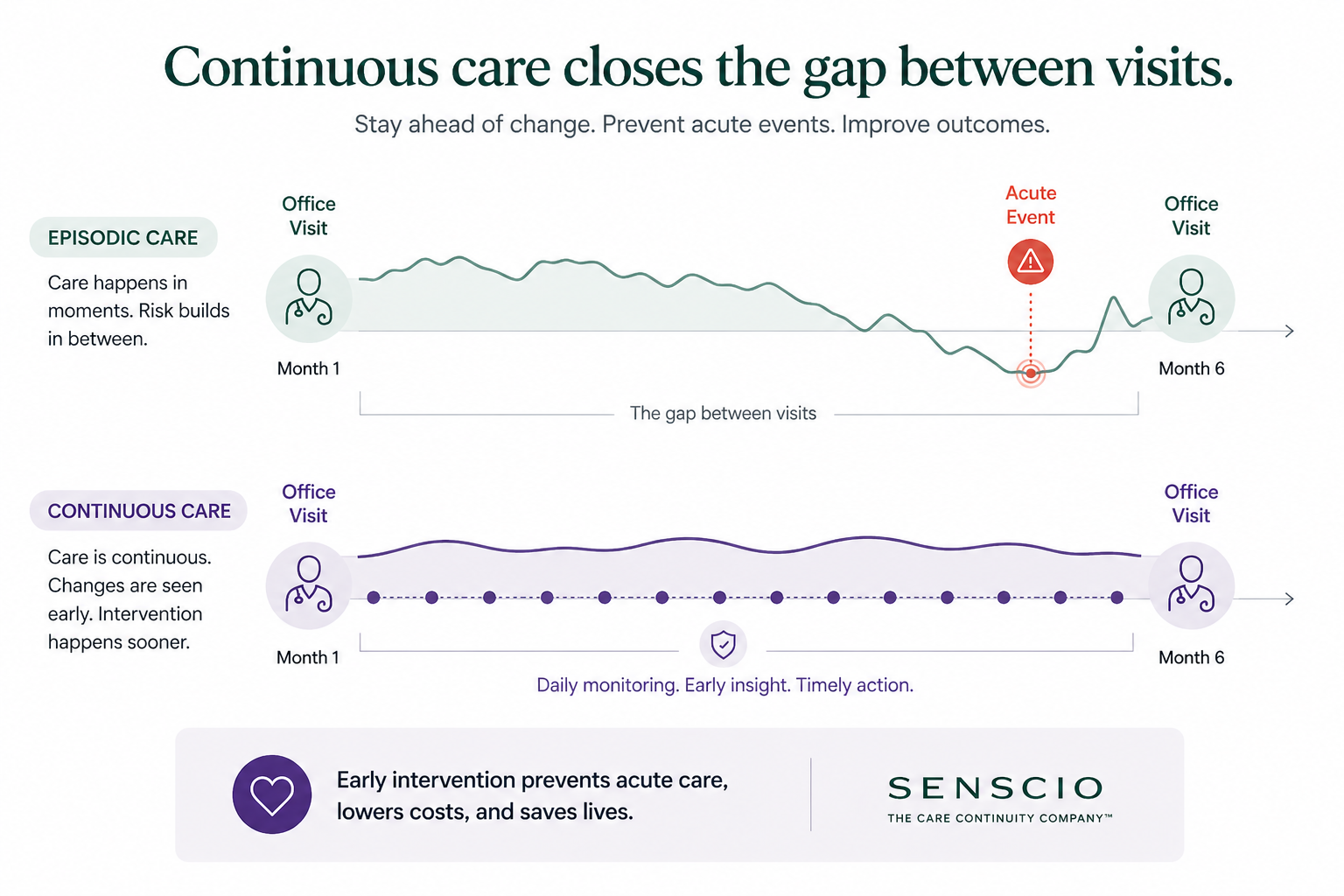
Healthcare is episodic, but health changes continuously.
Most healthcare systems are built around isolated moments: appointments, admissions, discharges, and urgent calls. But for people living with multiple chronic conditions, risk often builds gradually between those encounters.
Symptoms shift. Medications are missed. Habits slip. Support breaks down. By the time deterioration becomes visible inside an episodic model, the member may already be in crisis.
Risk builds most silently at home, between encounters, when no institution has a continuous view of the member.
Continuous care is an outcome, not a service.
Continuous care is achieved when the right action is taken by the right person at the right time in an effective way. That requires a persistent understanding of the member and a Care Circle that can respond when the member’s health state changes.
The Care Circle is the people and organizations through which the member receives care. Different members of the Care Circle step in and step out as needs change; Healthcare Continuity Infrastructure keeps that care connected over time.
Continuous care is not just more touchpoints.
Episodic care
Action happens mainly at isolated moments, with limited continuity between encounters.
More touchpoints
Adding more calls or tasks may increase contact, but it does not by itself create continuous understanding.
Healthcare Continuity Infrastructure
Maintains persistent understanding, detects meaningful change, determines who should do what, when, why and how, and follows actions through to completion.
Senscio built Healthcare Continuity Infrastructure.
Healthcare already has providers. What has been missing is the infrastructure that keeps care continuous between them and follows the member wherever care occurs—including the home.
Ibis provides that infrastructure. It maintains persistent understanding of the member, detects meaningful change, determines who should do what, when, why and how, and helps the Care Circle close the loop.
Healthcare Continuity Infrastructure scales by enabling the providers that already exist.
Healthcare already has hospitals, medical practices, home health organizations, and community providers. Ibis enables them to add continuous care capability rather than requiring a new healthcare delivery system to be built from scratch.
As more members and organizations participate, the HealthGraph grows, the Operating System becomes better informed, and every deployment strengthens the continuity network.
See how continuous care becomes real in practice.
The Platform
See how DT4H™, HealthGraph™, and Ibis™ work together to make continuous care operational.
Clinical Model
See how human judgment and compassion are deployed inside the system.
Outcomes
See the measurable impact of continuous care across clinically complex populations.
Let’s talk about how your organization can deliver continuous care.
We work with health plans, hospitals and health systems, medical practices, home health organizations, and other provider partners that want to keep care continuous wherever their members receive it.